
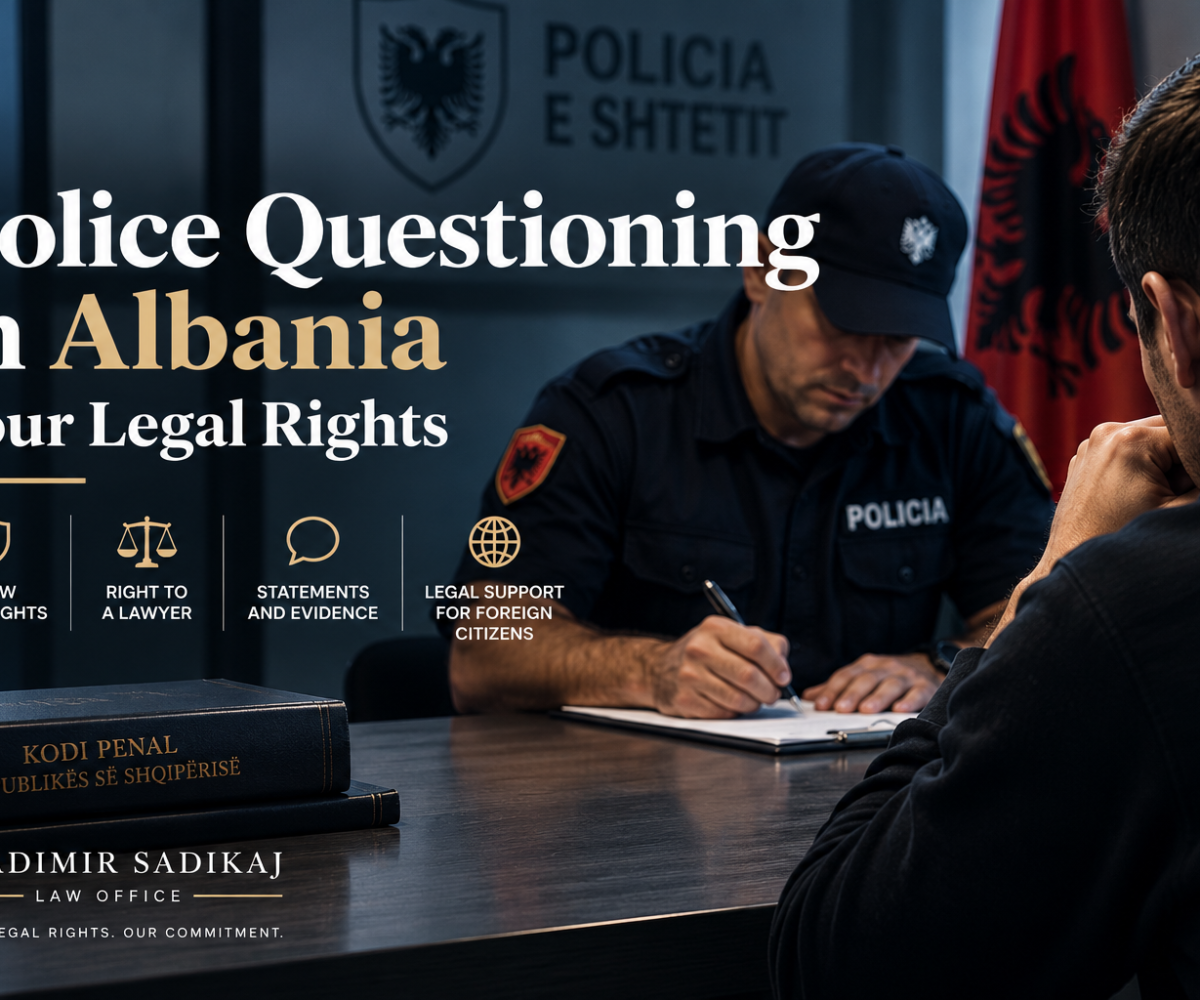
Police Questioning in Albania | Your Legal Rights
Being questioned by the police in Albania can be a serious legal matter, particularly when the questioning concerns a suspected criminal offense. For a foreign citizen, tourist or resident, the situation can be even more difficult because the person may be unfamiliar with Albanian criminal procedure and may not fully understand the legal significance of the questions being asked.
Albanian criminal procedure provides important rights to persons under investigation and defendants, including the right to understand the allegations, the right to remain silent, the right to legal defense and, where necessary, the right to interpretation. These rights should be understood before a person makes important decisions during a criminal investigation. [oai_citation:0‡QBZ](https://qbz.gov.al/alfresco/webdav/Botime%20Zyrtare/Kodet/Ligj%20Nr.7905%20date%2021.3.1995%20-final.pdf?utm_source=chatgpt.com)
What Does Police Questioning Mean in Albania?
Police questioning may form part of a criminal investigation. The circumstances of the questioning and the person’s procedural position are therefore important.
A person may be questioned in connection with information, evidence or allegations concerning a potential criminal offense. The legal consequences depend on the circumstances of the case and on the person’s status within the proceedings.
For this reason, being asked to attend a police station should not automatically be treated as either a minor formality or proof that a person has committed an offense.
Your Procedural Position Matters
One of the first issues a criminal defense lawyer should establish is the person’s exact procedural position.
The legal position may affect the rights available to the person, the information that must be provided to them and the way in which the questioning should be approached.
Where a person is under investigation or has been attributed a criminal offense, Albanian criminal procedure provides specific rights and guarantees concerning defense and communication with counsel. [oai_citation:1‡QBZ](https://qbz.gov.al/alfresco/webdav/Botime%20Zyrtare/Kodet/Ligj%20Nr.7905%20date%2021.3.1995%20-final.pdf?utm_source=chatgpt.com)
Your Right to Know Why You Are Being Questioned
A person under investigation or a defendant has the right to be informed, in a language they understand, of the criminal offense being investigated and the reasons for the allegations.
This is particularly important for foreign citizens who may not understand Albanian legal terminology or the precise nature of the allegations being considered by the authorities. [oai_citation:2‡QBZ](https://qbz.gov.al/alfresco/webdav/Botime%20Zyrtare/Kodet/Ligj%20Nr.7905%20date%2021.3.1995%20-final.pdf?utm_source=chatgpt.com)
Your Right to Remain Silent
Albanian criminal procedure recognizes the right of a person under investigation or a defendant to remain silent, to present their defense freely and not to answer particular questions.
The decision whether and how to respond to questions should be considered in light of the specific circumstances of the case and the person’s procedural position.
Obtaining legal advice before making significant statements can be particularly important where the questioning concerns a potential criminal offense. [oai_citation:3‡QBZ](https://qbz.gov.al/alfresco/webdav/Botime%20Zyrtare/Kodet/Ligj%20Nr.7905%20date%2021.3.1995%20-final.pdf?utm_source=chatgpt.com)
Your Right to a Criminal Defense Lawyer
A person under investigation or a defendant has the right to defend themselves or with the assistance of a defense lawyer of their choice.
Depending on the circumstances and applicable legal requirements, state-appointed defense may also be available where defense is mandatory or the person does not have the financial means to appoint a lawyer.
The person also has the right to meet and communicate privately with their defense lawyer. [oai_citation:4‡QBZ](https://qbz.gov.al/alfresco/webdav/Botime%20Zyrtare/Kodet/Ligj%20Nr.7905%20date%2021.3.1995%20-final.pdf?utm_source=chatgpt.com)
Why Legal Representation During Questioning Matters
The role of a criminal defense lawyer is not simply to attend a police interview.
The lawyer should first understand the allegations, establish the client’s procedural position and assess the circumstances surrounding the investigation. The lawyer can then advise the client regarding the appropriate legal approach.
Depending on the circumstances, the lawyer may also review relevant documentation, assess available evidence and identify procedural issues that may become important during the investigation or subsequent court proceedings.
Police Questions and Criminal Evidence
Information obtained during an investigation may become relevant to the criminal proceedings. Statements, documents, physical evidence, electronic communications, witness accounts and other material may form part of the evidentiary picture.
This means that a person should not consider police questioning in isolation. The significance of an answer depends on the allegations, the evidence already available and the wider circumstances of the investigation.
A criminal defense lawyer assesses these matters as part of the overall defense strategy.
Do Not Assume That Questioning Means You Will Be Arrested
Being questioned does not automatically mean that a person will be arrested or detained.
The procedural consequences depend on the circumstances and the applicable legal requirements. However, where questioning is connected to a serious criminal investigation, the person’s legal position should be assessed carefully from the beginning.
Where arrest or another security measure subsequently becomes relevant, immediate legal representation may become particularly important.
Police Questioning and Foreign Citizens
Foreign citizens may face additional difficulties when questioned by Albanian authorities.
These may include language barriers, unfamiliarity with Albanian criminal procedure, uncertainty concerning documents and difficulty understanding the legal consequences of particular statements.
Albanian criminal procedure provides that a person under investigation or a defendant may use the language they speak or understand and may be assisted by an interpreter where required. [oai_citation:5‡QBZ](https://qbz.gov.al/alfresco/webdav/Botime%20Zyrtare/Kodet/Ligj%20Nr.7905%20date%2021.3.1995%20-final.pdf?utm_source=chatgpt.com)
Independent legal representation can therefore provide an important connection between the foreign client and the Albanian authorities.
Can a Tourist Be Questioned by Albanian Police?
Yes. A person’s status as a tourist does not prevent Albanian authorities from conducting a criminal investigation where there are relevant circumstances.
A tourist who is questioned should establish why they are being questioned and what their procedural position is before making important decisions concerning the investigation.
Where the matter concerns a potential criminal offense, contacting a criminal defense lawyer as early as possible can help ensure that the person’s legal rights and interests are properly addressed.
What Happens After Police Questioning?
The next stage depends entirely on the circumstances of the case.
The investigation may continue, additional evidence may be collected, the person may be questioned again, or the matter may proceed through the prosecutorial and judicial stages of criminal procedure.
In more serious cases, issues concerning arrest, detention or other security measures may also arise.
A lawyer can assess the available information and advise the client regarding the appropriate legal response.
Police Questioning and Pre-Trial Detention
Police questioning and pre-trial detention are separate procedural matters. A person who is questioned is not automatically placed in detention.
Where a security measure is sought or imposed, the defense must assess the legal basis for that measure and the circumstances relied upon by the competent authorities.
For foreign citizens, this can also raise practical issues concerning travel, residence and communication with family members abroad.
What If You Believe the Police Questioning Was Improper?
If a person believes that their procedural rights were not respected or that an investigative action was conducted improperly, the matter should be assessed through the appropriate legal mechanisms.
The defense lawyer can review the circumstances, relevant documentation and applicable procedural provisions and determine whether a legal objection, request or other procedural measure may be appropriate.
Such issues should be addressed through the legal process rather than through confrontation with the authorities.
Why You Should Not Treat Police Questioning as a Simple Conversation
When questioning concerns a potential criminal offense, the information provided may become relevant to the investigation.
A person may believe that explaining the situation informally will resolve the matter. However, without understanding the person’s procedural position and the evidence already available, it can be difficult to assess the legal consequences of particular statements.
This is why independent legal advice can be important before and during significant stages of a criminal investigation.
Why Choose Vladimir Sadikaj Law Office?
Vladimir Sadikaj Law Office provides independent criminal defense and legal representation in Albania for Albanian and foreign citizens involved in criminal investigations and proceedings.
The role of the lawyer is to assess the legal position of the client, analyze the allegations and available evidence, protect procedural rights and develop an appropriate defense strategy based on the circumstances of the individual case.
Where instructed, representation may extend from the initial investigation and police questioning through prosecutorial proceedings, security-measure hearings and criminal court proceedings.
If You Have Been Asked to Attend a Police Station
If you have been contacted by the Albanian police in connection with a potential criminal matter, you should first understand why you are being contacted and what your procedural position is.
If the matter concerns a suspected criminal offense, obtaining independent legal advice before making significant statements can be important.
For foreign citizens, professional legal representation can also help overcome language and procedural difficulties and provide a direct legal point of contact in Albania.
Frequently Asked Questions
Do I have to answer police questions in Albania?
The applicable rights depend on your procedural position. Albanian criminal procedure recognizes the right of a person under investigation or defendant to remain silent and not answer particular questions. The appropriate approach should be assessed in the circumstances of the individual case.
Can I have a lawyer during police questioning in Albania?
Yes. Albanian criminal procedure provides for the right to defend oneself or with the assistance of a defense lawyer and recognizes private communication with the defense lawyer. [oai_citation:6‡QBZ](https://qbz.gov.al/alfresco/webdav/Botime%20Zyrtare/Kodet/Ligj%20Nr.7905%20date%2021.3.1995%20-final.pdf?utm_source=chatgpt.com)
Can a foreigner have an interpreter during criminal proceedings in Albania?
Yes. The Criminal Procedure Code provides rights concerning the use of a language the person speaks or understands and assistance by an interpreter where applicable. [oai_citation:7‡QBZ](https://qbz.gov.al/alfresco/webdav/Botime%20Zyrtare/Kodet/Ligj%20Nr.7905%20date%2021.3.1995%20-final.pdf?utm_source=chatgpt.com)
Does police questioning mean that I am under arrest?
No. Questioning and arrest are different procedural matters. The legal consequences depend on the circumstances and the person’s procedural position.
Can police questioning lead to criminal charges?
Questioning may form part of a criminal investigation. Whether criminal charges are ultimately brought depends on the circumstances, evidence and applicable criminal procedure.
Should I contact a criminal lawyer before going to the police station?
Where the matter concerns a potential criminal offense, obtaining legal advice before significant questioning can help you understand your procedural position, rights and available legal options.
Conclusion
Police questioning in Albania can be an important stage of a criminal investigation. For a person under investigation, understanding the allegations, procedural position and available legal rights is essential.
Foreign citizens and tourists may face additional difficulties because they are unfamiliar with Albanian criminal procedure and may not fully understand the language or legal consequences of the proceedings.
Independent criminal defense allows the person’s legal position to be assessed from the beginning and provides professional representation throughout the relevant stages of the investigation.
If you have been contacted or questioned by the Albanian police in connection with a potential criminal matter, obtain independent legal advice as early as possible.